The Frustration
We'd browsed the Spotlight website online before arriving, so we came armed with a couple of choices in mind. While we found the curtain section quickly along with our preferred choice, we hit a stumbling block - it seemed we could find every size other than the one we needed. But the selection is enormous with a maze of racking, could we just be not seeing it?
No worries I thought, we'll just jump back onto their website and see if they actually have stock. Uh oh, zero bars of 4G. No matter our attempts to refresh the page it wouldn't load.
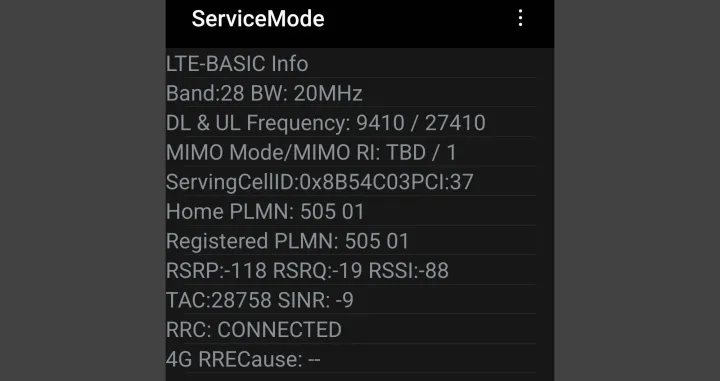
My phone was still showing a connection however, so I dialled *#0011# to access engineering mode, receiving instant side-eye from my companion who patiently deals with my fascination for the thousandth time.
4G signal was fluctuating from about -123 to -118 dBm with a cripplingly bad SINR, and 5G was of course nowhere to be seen, so I began wandering and found a spot in the store with enough signal to load the page, lo and behold the size was indeed in stock.
After returning, heroically, to my waiting wife we found the size on the top shelf placed behind a larger size. Success, and off to the checkout we went.
Even though we'd managed to triumph, the experience made me wonder how many others had faced the issue not just in this Spotlight, but the whole precinct was a dead zone - Anaconda, Fantastic Furniture, among the other big names, not to mention the cafe with their QR code menus.
How many had got to the checkout only to need to use their banking app to shift money from savings to spendings, how many had chased down a customer service member for help only for the employee to battle the same problem on their inventory app.
The Cause
As soon as I got home, I abandoned my curtain installation duties and logged straight into Axidra CI to see why Telstra 4G signal was so bad.
In short: the cause was primarily building orientation with respect to where the towers were located.
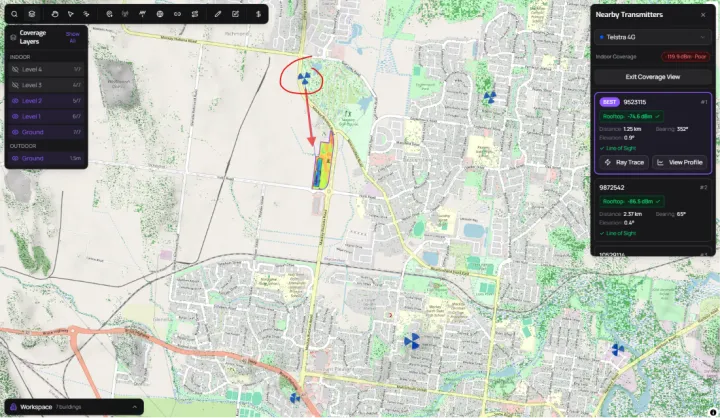
From a 16 metre rooftop position our CI tool was showing good signal strength, -73 dBm - a full 5 bar signal, with the best serving transmitter only 1.25 km north, no obstructions, and directly in boresight (meaning the tower's antenna is aimed in the direction of the retail precinct).
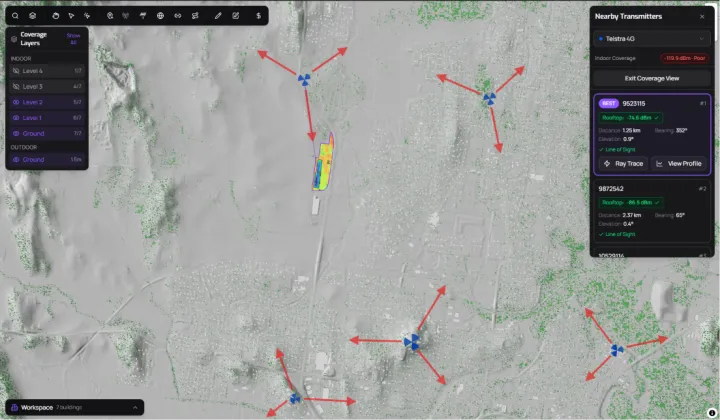
The area has five Telstra 4G and 5G enabled towers in relatively close proximity, I generated a quick RSRP coverage model to confirm there were no foundational issues with the network itself.
What we see below is firstly the RSRP "heatmap" showing signal strength coloured from red (hot/strong) to blue (cold/weak). It tells us there are no major misfortunes, like hills or forests, that there are plenty of towers around, and outdoor coverage is generally good.
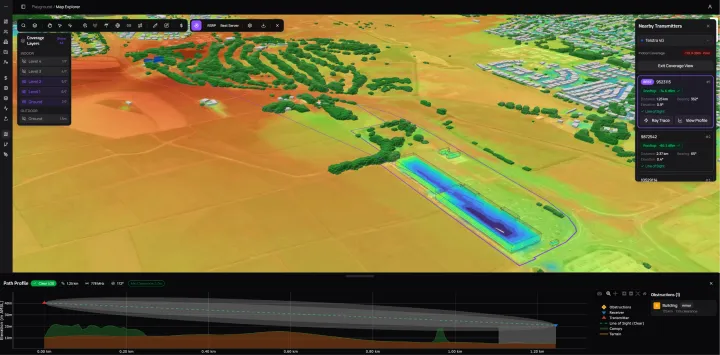
The most revealing factor is that the only tower aiming its antenna in the direction of the retail precinct, and that signal impacts the precinct almost along an enfilade vector - signal that doesn't glance off the side of the concrete must pass through a lot of material to reach the core.
We can see from the grey (terrain) view image below that there are no other strong secondary sites, with the second closest tower to the east while sitting in a defilade position, its antennas face off-boresight, leaving the building in an overlap zone between the two sectors.
The Solution
The technical fix is quite straight forward. Large Retail Format precincts are plagued by this challenge - they're large concrete and metal structures packing in a lot of inventory, and customers expect a frictionless mobile-first experience. The good news is this means we're very familiar with the solution.
With the precinct measuring roughly 14,000 square metres but with minimal occupancy (perhaps a few hundred on a busy Saturday), it's firmly within scope of an IBC solution - a type of coverage system that's designed for affordable broad-area indoor mobile connectivity.
The role of an IBC is to alleviate building penetration issues caused by thick construction materials. There's nothing wrong with the surrounding mobile network, so we use an externally mounted receiver and output an amplified version of that same signal inside. So what does that look like?
Large Retail Format IBC
Beyond access to reliable calling for safety and compliance purposes, a key driver for coverage in retail is enablement of the app-first / mobile-first experience. This means any solution implemented should cover the majority of customers (typically all three - Telstra, Optus, and Vodafone), as well as deliver adequate Signal to Noise (SINR) and multiple radio carriers to both provide good data speeds and enough capacity to protect performance from peak hour slow-downs.
Given the large size of these buildings, older coaxial-based "passive" DAS are generally not viable, and require Hybrid or Active IBC technology. These systems use fibre optic and/or Cat6 ethernet to place Coverage Nodes around the building, which either have integrated antennas or each branch off into small runs of multiple antennas.
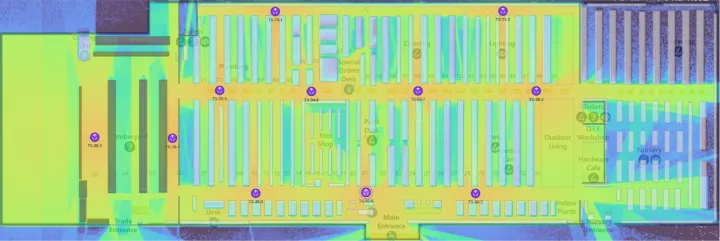
As I couldn't find a floor plan for this specific building, I thought it would be good to illustrate what this solution looks like using the neighbouring Bunnings which is of similar dimensions and layout, courtesy of them publishing their store layouts online.
The Axidra Cloud platform allows us to load and trace the building floor plan, placing our IBC Coverage Nodes to predict indoor coverage. Powered by an advanced 3D physics engine, we draw the exterior perimeter, assign floor material, ceiling and roof materials and heights, and then begin detailing in pallet racking and palletised inventory at their estimated heights. We could spend all day detailing down to centimetre-level accuracy, but for the purposes of this blog we've traced quickly.
We can see from the below example that a typical tilt-panel concrete LRF precinct would require around 10-12 Nodes to achieve adequate coverage. We might use fewer if only basic calling/data services were required, or we might increase density if the client needed high speed 5G data. We've excluded the outdoor nursery and landscaping areas as they are partially open and would have signal available from the Telstra tower directly.
Typical Costs
Large Retail Format IBC costs are driven primarily by floor area, density of inventory, and ceiling height, and of course whether the site is greenfield (new) or brownfield (existing). With 14 metre high ceilings this isn't simple ladder work, and working around a site filled with pallet racking or dense inventory makes maneuvering a slow and costly process.
That means estimates can vary widely, but by way of a rough order of magnitude, costs for a 14,000 sqm 4G-5G IBC that covers Telstra, Optus, and Vodafone networks might range from $150k to $300k.
One of the major advantages of an IBC solution is that we're passing the 4G and 5G signals available outdoors to the areas that need it indoors. That's an important distinction - if half of the building already has adequate signal, then we only need to enhance signal for the remaining half. This means you only pay for the areas you need.