
Why Small Offices Have Coverage Problems
Location and Layout
Small offices are often at ground level, nested between or behind other buildings. Mobile coverage might reach the shop front where the window faces the street, but back-of-house areas sit in a shadow. The storeroom, the break room, the office behind the counter - these spaces often have weak or no signal.
Network operators design their coverage for population centres and major corridors. A small office tucked behind a shopping strip or down a laneway doesn't register as a priority. The assumption is that outdoor coverage is "good enough" for the area, but that doesn't account for what happens once you step inside.
Staff adapt by switching to WiFi calling, which helps until someone unexpectedly loads a video or a software update kicks off. Suddenly calls drop or audio turns choppy. The workaround becomes its own source of problems.
Demountable Buildings
Site offices, temporary facilities, and demountable buildings present a particular challenge. These structures, which we call "dongas" in Australia, are typically clad in steel or aluminium coolroom panelling. Metal cladding blocks RF signal almost completely, with signal having to reach in through an open door or small window. Signal that works fine elsewhere on the site disappears the moment you step through the door.
This affects construction sites, mining operations, events, emergency response facilities, and any situation where temporary buildings are deployed. Workers inside these structures often have no mobile connectivity despite being surrounded by adequate outdoor coverage. Staff productivity falls from lost calls, delayed messages, not to mention plain frustrating having to stand outside in the weather to make a call.
Windows provide some signal entry path, but demountables often only a couple of windows and use metal security screens which turn the building into a "Faraday Cage". The limited aperture means signal inside is weak and inconsistent, with coverage that varies depending on where you stand.
Remote Locations
Small offices aren't always in metro areas with strong mobile networks. Regional branches, national park facilities, forestry operations, and rural businesses often contend with weak source signal before building materials enter the equation.
When the signal outside is already marginal, losses through walls and windows can push indoor coverage below usable levels. These situations require solutions that both capture what signal exists and distribute it effectively indoors.
Solutions for Small Offices
Single Building, Simple Setup
For a single small office or demountable, the most straightforward solution is a roof-mounted external antenna connected to a mobile booster. The antenna captures signal from outside the building where it's stronger. The repeater amplifies this signal and broadcasts it indoors.
A repeater like the Cel-Fi R41 provides enough power to cover a shipping container or crib room. It works with a single mobile network operator at a time. Installation can be handled by a local electrical contractor or self-installed using guidance from an Axidra Desktop Survey, which identifies the best antenna placement and repeater configuration for your specific building and signal environment.
Multiple Buildings or Larger Spaces
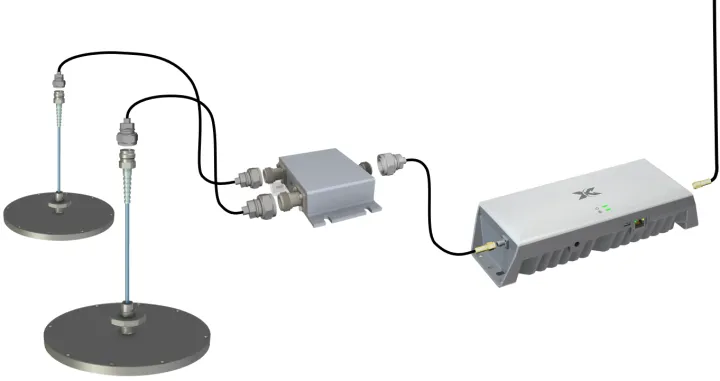
When coverage is needed across several demountables or a more complicated space, the solution scales up. A more powerful repeater like the Cel-Fi G41 can drive multiple internal antennas through a signal splitter. Each antenna covers its own area, whether that's separate buildings in a demountable village or different rooms within a larger office.
The external antenna and repeater remain central. Coaxial cable runs from the repeater to a splitter, then to each internal antenna. This approach can cover clusters of demountables commonly found on construction and mining sites.
Permanent Small Offices
For offices with long-term tenancy, or for more business-critical connectivity a more advanced repeater system may be a better choice. A remotely managed and monitored In-Building Coverage system that combines the affordability of repeaters into a more professional multi-carrier solution provides business-grade connectivity with business-grade support.
The decision depends on the building's permanence, the coverage requirements, and the business case. A temporary site office that will be relocated in six months suits a repeater. A branch office with a five-year lease may justify a more capable system.
Axidra can advise on the right approach for your situation.
Managing Multiple Sites
The real complexity for many businesses isn't any single office, it's managing coverage across many locations. A national retailer with 50 branches has 50 different buildings, 50 different signal environments, and potentially 50 different coverage solutions. When something goes wrong at a regional branch, diagnosing the issue remotely is difficult without visibility into what equipment is installed and how it's performing.
Axidra Cloud addresses this by bringing all sites into one platform. Each office, whether it's running a simple repeater or a full IBC system, can be monitored through the same dashboard. IT managers can see which sites are performing well and which need attention. When issues arise, 3D modelling of the building and its coverage helps diagnose causes without a site visit.
This same visibility applies whether you're managing a handful of offices or hundreds. The platform scales with your portfolio.