
Why is Mine Connectivity Challenging?
Poor connectivity is rarely the result of a single factor. A combination of remoteness, congestion, terrain, and the mine environment itself all play a part in the challenge.
Remoteness
Mobile networks in Australia are planned to serve people – not pits. Operators build towers where there’s population density, transport corridors, or high public use areas like townships and beaches. Mine sites, by contrast, are typically located where few people live and where mobile coverage was never commercially justified.
That’s not by accident. Mining leases are almost always granted in remote zones, far from communities, meaning mobile operators have no incentive to invest in coverage. As a result, connectivity is often non-existent until the mine makes it happen.
A look at Australia’s known mineral deposits shows that only 21% fall within close range of a cell tower, 56% are likely to be intermittently covered, and 22% lie completely beyond the reach of mobile networks. In other words, most mine sites begin life with compromised or no connectivity.
Looking at operational mines, 47% of mines in Australia have commissioned their own towers, reducing the number of sites operating without any coverage down to 10%. The remaining 42% rely on whatever public network happens to be nearby, which often requires coverage enhancement or augmentation to meet operational demands.
Congestion
Augmentation, such as the use of mesh WiFi or private networks, is frequently required for sites relying on the public network because of the traffic generated by the surrounding community.
All forms of wireless connectivity are shared resources, where each user competes against every other user for resources. The two major bottlenecks are explained below.
Terrain
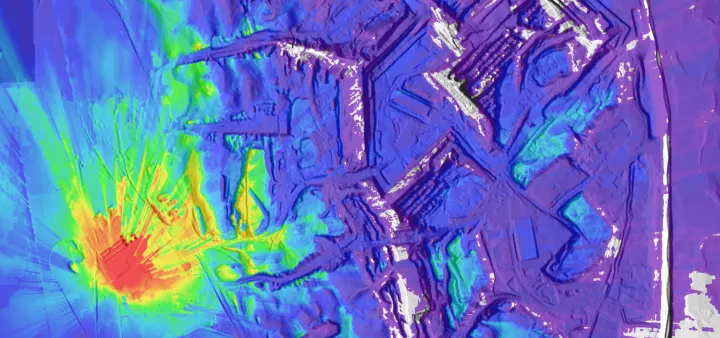
It shouldn't be a surprise to anyone that terrain is the most challenging factor for open cut mine connectivity. Walls, benches, berms, ramps, dumps, stockpiles, forever changing.
Even for the 47% of mines with dedicated cell towers, obtaining a 4G-5G connection everywhere you need it can be a constant battle. Because it's not practical to change the cell tower, to deal with terrain blackspots the mine will typically need to lean on a combination of coverage enhancement using antennas and repeaters, and augmentation using alternative connectivity technologies.
Building Materials
Metal and RF signal are not friends. Signals in the mobile and WiFi bands, and even VHF/UHF mine radio, struggle to penetrate metal-clad structures. Unfortunately, mine sites are full of them: demountables, shipping containers, hangars, processing plants, all typically skinned in steel or aluminium.
Signal that does reach indoors usually enters through windows, open doors, or other non-metallic gaps. But this can be misleading. Just because air and light can pass through a structure doesn't mean RF can. If a façade or security mesh has metal spacing narrower than the signal’s wavelength, the signal will be blocked.
Lower-frequency signals like those used in UHF mine radio have longer wavelengths and are blocked by wider gaps than higher-frequency signals like 5G. The effect however is balanced out by transmitting louder and with a wavelength that travels more easily over distance and terrain.
Overcoming these effects requires intentional system design, simply placing a tower nearby won’t guarantee indoor performance.
Mine Connectivity Solutions
Whether your mine is one of the 47% with a dedicated 4G-5G base station or not, you'll still need to address problem areas.
Solutions tend to be divided into coverage enhancement where you're looking to improve the performance of 4G-5G connections, or augmentation where you're bridging a gap with an alternative technology.
Step one should always be to understand the problem in detail, connectivity issues may be more widespread, or changed since last audited. To perform a Desktop Survey, Axidra will typically request copies of recent aerial imagery along with LIDAR scans of your area of concern, this can be in the form of contours, dxf, point cloud, etc., your surveyors will have this information available. We use this information to identify all structures/buildings, vegetation, and of course the 3D geometry of your pits, dumps, and roads.
While there's no obligation, the survey will constitute part of the solution's Preliminary Design.
The types of solutions commonly deployed are discussed briefly below.
Temporary Buildings & Demountables
To improve mobile connectivity in ATCO-style dongas, the quickest and cheapest solution tends to be a simple roof mounted antenna connected into a repeater like the Cel-Fi R41. This repeater model has enough power to cover about the size of a shipping container or your typical crib room.
You won't need a specialist to install this solution, your site-inducted electrical contractor can obtain the kit from their local wholesaler and use the information provided by our Desktop Survey to tune the system. If it's a particularly challenging scenario, we can help arrange one of our partners who specialises in mining installations to assist.
For groups of multiple demountables the solution requires a few more components. If you're dealing with just a handful of dongas, a more powerful repeater like the Cel-Fi G41 can be used. It's output will need to be split to feed multiple antennas, with one placed in each separate building. We'll help your preferred electrical contractor to source the right parts. Learn more about Repeaters
In-Pit Connectivity
Operational systems, particularly autonomous systems, require reliable and high performance connectivity. With 90% of operational mine sites having some form of 4G-5G network nearby, there's practical value in enhancing its reach rather than building a separate connectivity system.
One of the major blackspots for public 4G-5G networks is connectivity down in pits. Where even a weak signal is available on a bench or wall, coverage can be extended down into the pit by use of a skid or trailer with a specialised repeater configuration. The trailer picks up the signal using a high gain antenna, and a strong signal is broadcast through an antenna aimed down into the pit. This can be a highly affordable and rapidly deployable solution that can be moved or readjusted as the operation evolves.
For areas where no mobile connectivity exists, a similar system can be deployed with a Private 5G or Industrial WiFi transmitter used instead of a repeater. Because this kind of solution require careful scoping, Axidra will first perform a series of design simulations and then engage a partner who specialises in mining telecommunications to execute the solution.
Processing Plant & Facilities
Large buildings or large groups of buildings require a more involved In-Building Coverage solution.
For sites with an existing cell tower, or public tower nearby, improving mobile connectivity throughout even large facilities can be highly cost effective. A series of coverage nodes are installed throughout the facility and connected back to a central hub using Cat-6 ethernet or fibre optic cabling. This hub receives its 4G-5G signal either from roof-mounted antennas, or from equipment supplied by the Network Operator like a Small Cell.
Other technologies such as Industrial WiFi, Private 5G, BLE, LoRa, etc., can be installed at the same time, saving time and money.
These are a special class of coverage solutions that need to be professionally designed and coordinated with the Mobile Network Operator for approval. Rest assured, we'll take care of it from end-to-end. To begin the process, hit the button below.